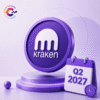

Kraken Parent Payward Delays IPO to Q2 2027

TL;DR
The short version
- 1Payward, which is the parent company of crypto exchange Kraken, has postponed its planned US IPO back to at least Q2 2027; being the second delay to its listing timeline this year.
- 2The company privately filed a draft S-1 registration statement with the SEC in November 2025, just briefly after fundraising $800 million at a $20 billion valuation, including $200 million from Citadel Securities.
- 3Payward first froze its IPO plans in March 2026 referencing hard market conditions; Q2 2026 revenue however still grew 17% to $508 million, but adjusted EBITDA cratered 71% and its trading volume fell with about 13%.
- 4The holdup follows a wider pullback across the industry: Grayscale, Consensys, and Ledger have all correspondingly postponed their own listing plans as well.
- 5BitGo, the only crypto-native company that accomplished its IPO in 2026, is trading 36% below its January IPO price; a cautionary data point private issuers are allegedly weighing before setting up their own dates.
What Changed
Payward is currently targeting the 2nd quarter of 2027 as the earliest for its long anticipated public debut, according to two people acquainted with the matter who spoke to Reuters on condition of anonymity, referencing the confidential nature of these discussions. A Kraken spokesperson declined to comment on the issue.
This isn’t the company’s first holdup. Payward privately handed in a draft S-1 registration statement to the SEC back in November 2025, briefly after closing an $800 million funding round over two tranches that valued the company at $20 billion, with market maker Citadel Securities donating $200 million of that raise.
The company seemed to be on an explicit path towards a near-term listing at that occasion. Then in March 2026, Payward ceased those plans completely, citing difficult market conditions and a reducing demand for new crypto stock listings. This latest report prolongs that pause by approximately another 365 days, pushing the earliest practical listing date out to Q2 2027; provided no further delays emerge between now and then.
Since the S-1 filing remains confidential, Payward is yet to publicly reveal a proposed share price, ticker symbol, target exchange, or offering size. Any actual IPO timeline is still relying on SEC review, existing market conditions, and Payward’s own final decision on whether to proceed at all.
The Numbers behind the Delay
Payward’s fundamental financial performance outlines a different narrative; one that aids in explaining why the company is proceeding with caution over pushing ahead regardless. Second-quarter 2026 adjusted revenue soared 17% year-over-year to $508 million, and the company reported that funded accounts reached a record high at the same period. On paper, that’s impeccable growth.
But profitability showcases another story. Adjusted EBITDA cratered to just $23 million, a 71% drop from the prior year, even as revenue surged. Trading volume, simultaneously, fell 13% to $310 billion for the quarter. This whole situation; of big revenues along with collapsing profitability and decreasing trading activity showcases a business taking on real cost pressure and softer core trading demand, with its growing user base.
This is not the kind of financial profile that contributes to an especially compelling public-market debut story, and Payward’s leadership seems to have concluded something of the same sort
The company is already taking cost-cutting steps consistent with that read. In May 2026, Payward retrenched about 150 employees, approximately 5% of its workforce, framing the reductions as part of a wider cost-discipline push attached to efficiency gains from AI implementation.
Not the Primary Motivation, According to Kraken’s Own Leadership
Kraken co-CEO Arjun Sethi spoke of the company’s IPO aspirations directly at an industry conference in April, affirming the confidential SEC filing while emphasizing that gaining access to public capital markets wasn’t the major motivation behind the company’s listing plans initially.
That perspective is worth keeping in mind: if going public was never about requiring the capital, a company within that position has considerably more room to simply ride out unfavorable conditions than one under actual pressure to collect funds on a specific timeline.
Payward’s readiness to push its own listing back a second time, even after successfully raising $800 million privately at a premium valuation, is in line with that framing.
A Wider Pattern Across the Industry
Payward is not the only one facing delays. It’s just the latest entry in a broader retreat from crypto IPOs all through 2026. Grayscale, Consensys, and Ledger have all likewise postponed their own public listing plans this year.
Ledger’s case is particularly noteworthy. The hardware wallet maker had already employed Goldman Sachs, Jefferies, and Barclays as advisers and was prepping for a US debut that could have valued the company at approximately $4 billion, yet halted those preparations without ever filing a draft S-1.
The one crypto-native company that indeed launched its IPO in 2026, BitGo, offers a cautionary data point for any entries still weighing the timing. BitGo’s stock is currently trading 36%, way below its January IPO price; which is a huge performance gap private issuers are allegedly considering directly into their own decisions about when, or whether, to set a listing date.
When the one comparable company that in fact went public is trading well underwater compared to its debut price, it becomes substantially harder to argue that now is the time for anyone else to follow.
This pattern signifies a sharp reversal from where the industry stood entering 2026. Crypto companies had returned to US equity markets in 2025 subsequent to the successful debuts of stablecoin issuer Circle and CoinDesk’s owner Bullish, and the expectation heading into this year was a sincere wave of crypto IPOs building on that momentum.
Instead, dropping digital asset prices and weaker trading activity all through 2026 made that initial schedule progressively difficult for multiple companies to sustain simultaneously.
Conclusion
Payward’s second IPO hold up this year is less of a narrative about any single company stumbling and more of an indication on where the broader crypto IPO market actually sits going into 2027.
A company with growing revenue, a good number of funded accounts, and $800 million in recent private funding at a $20 billion valuation still decided to wait instead of pushing forward , and it’s doing so along with Grayscale, Consensys, and Ledger, with BitGo’s underwater stock price being a visible warning sign for the whole group.
Whether Q2 2027 holds as the real target, or becomes yet another placeholder date that slips even further out as conditions come up, will likely rely on whether crypto trading volumes and valuations significantly recover before then.
This is a developing story. We’ll update this piece as Payward provides further guidance on its IPO timeline or files an updated registration statement.
Atlas Editorial
Writers, Researchers, and Editors
Atlas Editorial is a dedicated team of writers, researchers, and editors committed to delivering clear, insightful, and well-researched content. Our team brings together diverse perspectives to keep readers informed on the latest developments, trends, and ideas shaping the digital world.