How Does Blockchain Technology Actually Work?
TL;DR
The short version
A blockchain is typically a shared, duplicated transaction record scattered across many computers rather than one central authority. New transactions are sorted into linked “blocks,” therefore rendering past records beyond hard to alter. These networks agree on what’s valid via proof of work (Bitcoin) or proof of stake (Ethereum), and ownership of these assets is in form of private keys.
Anyone familiar with crypto space, has likely come across the term “blockchain”. Most users view it as “the technology behind Bitcoin”.
However, that’s a perception worth correcting, as once you fully understand how blockchain actually operates, other crypto concepts will begin to make sense; like why transactions can’t be reversed, why mining is important, and why the phrase “not your keys, not your coins” is common in this space. Each one of these concepts builds up on a small set of core principles.
This guide covers what a blockchain is, how it works, and why it was structured the way it is.
The Problem Blockchain Was Designed to Solve
In the earlier days before the existence of blockchain, sending digital money needed a trusted intermediary; usually a bank or payment processor to record who owned what. That intermediary preserves one official ledger, and users trust that record as they trust the institution maintaining it.
The problem with this approach is that it created a single point of failure. The institution could miscalculate, get hacked, freeze funds, or in other instances, act dishonestly. Additionally, there’s a key technical challenge that pops up when dealing with digital money: what’s stops one from copying their digital funds and typically spending the same units twice? This is commonly known as the “double-spend problem.”
Blockchain was essentially built to address both of these issues: how can a group of contributors who barely don’t trust one another get to agree on one, accurate, tamper-proof record, without depending on a bank, government, or company to mediate the process?
This core question is the true foundation for how blockchain technology actually works.
The Basic Idea: A Shared, Duplicated Ledger
Imagine a ledger that registers every transaction that has ever taken place. Instead of one institution preserving that ledger under its sole control, thousands of other identical copies are in existence concurrently, maintained by computers that are scattered around the world. When any new transaction happens, it’s registered across all of these identical copies at the same time.
So in an instance one attempted to alter their own copy, for example, to deceptively increase their balance; that copy won’t be identical to the rest of the network. The disparity would then be identified and rejected. To successfully forge the record, an intruder would be required to change the majority of copies at the same time, which becomes quite unrealistic once a network gets to a meaningful size.
This is the perception of blockchain at its most fundamental level: a shared, duplicated record preserved collectively by a network of computers, instead of one central authority.
Why It’s Called a “Chain” of “Blocks”
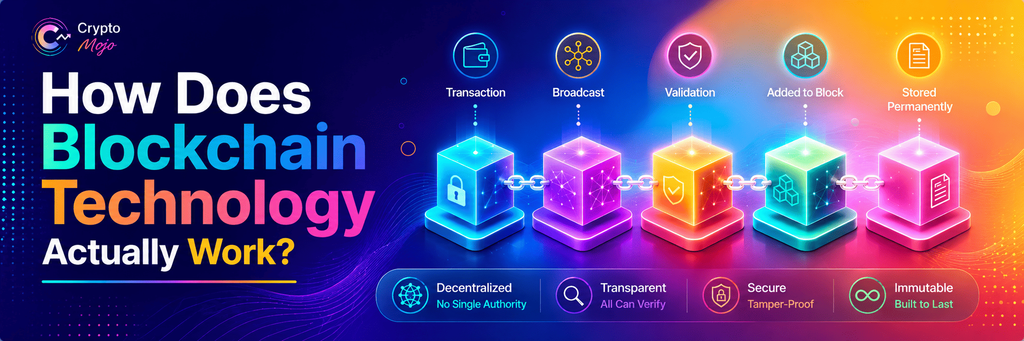
Transactions aren’t compiled to a blockchain separately or in an unorganized pile. They’re sorted together into small batches referred to as “blocks.” Each block comes with a set of transactions in combination with some technical metadata, and once a block is complete, it’s locked and attached to the chain.
Here’s the core mechanism: with each new block comes unique cryptographic fingerprint, known as hash, of the block that came before it. This fingerprint is essentially formulated by executing the previous block’s data via a mathematical function, and even a minor alteration to that earlier data would generate a completely different fingerprint.
Since each block acknowledges the fingerprint of its forerunner, the outcome is a literal chain; every block is cryptographically connected to the one before it, dating back to the very first block created.
This structure makes interference with historical records beyond difficult. Changing a transaction from a couple of years ago would alter that block’s fingerprint, hence fracturing the link to every block added afterward. An invader would inherently need to rebuild the entire chain from that point forward, over thousands of copies concurrently, while the honest network keeps on adding new legitimate blocks in real time. While this isn’t mathematically impossible, with a big network size, it’s rendered impractical to the point of being effectively unattainable.
How New Blocks Are Added
A key process in fully understanding how blockchain works is essentially learning how new blocks are added to the blockchain. This is the procedure that ensures the blockchain remains transparent, resistant-proof and accurate.
This process typically begins when users execute transactions on the blockchain network. For instance, when someone sends some crypto to another person, this particular transaction is broadcasted to all contributors, known as nodes.
At the core of it, an entity is required to make the ultimate decision of what goes into the next block, and what order should it follow. And an issue arises: who gets to execute this role and why should they be trusted.
And this is the exact point “consensus mechanisms” emerges; the rules a blockchain network employs to agree on what the next valid block should emulate, without having to depend on a single authority to make that decision. These are the two approaches that a blockchain network uses:
Proof of Work
This is the method that Bitcoin adopts. Computers on the network, known as miners, compete to solve a computationally difficult mathematical problems. The mathematical problems aren’t formulated to test creative problem solving; it involves some recurring trial and error, evaluating random values until one generates an outcome meeting a particular criteria. The first miner to discover a valid solution is rewarded the exclusive right to add the next block and receives a reward.
The computational effort that comes with this intentional. Solving difficult mathematical challenges needs real processing power and real electricity costs, which makes fraudulent behavior to be quite expensive. Amending the network’s history would need more computing power than the rest of the honest network combined, maintained continuously; an expensive cost that becomes economically illogical once a network reaches adequate scale.
Proof of Stake
Currently, Ethereum adopts this approach since 2022 where a particular amount of cryptocurrency is secured as collateral. The network then chooses who adds the next block based on factors such as, the amount staked, often consolidating an element of randomness.
If a validator tries to approve fraudulent transactions, they essentially risk losing the crypto assets they’ve staked, a penalty commonly referred as “slashing.” This attains a security objective that resembles proof of work, (making deceitful behavior an expensive venture).
Neither approach is impartially superior in every respect. Proof of work has an extended security track record and a simplified design, while proof of stake is substantially more energy-efficient and can process transactions quickly. Different projects have ranked these trade-offs diversely.

Olav Nilsen Quick Tip ⚡
A good way to separate these two consensus mechanisms: proof of work makes dishonest behavior costly by consuming more electricity, while proof of stake makes it costly by risking capital. The foundational goal is the same, only the resource at stake varies.
Nodes: The Computers That Run the Network
The term “node” pops up regularly, and its meaning is quite simple. A node is inherently a computer running the blockchain’s software and preserving a copy of the ledger. Some nodes simply store and validate data (often called “full nodes”), while others also contribute in creating new blocks, whether as miners or validators, that is depending on the network’s consensus mechanism.
The more independent nodes a network incorporates, spread across diverse individuals, organizations, and countries, the more decentralized and immune to censorship it becomes. A network with little to no nodes controlled by a one entity would not be purposely decentralized, despite of its underlying design. Part of what gives Bitcoin and Ethereum their grit is that thousands of independent nodes run their software globally, with no single party able to independently shut the network down.
Wallets, Keys, and What “Owning” Crypto Actually Means
One thing that causes confusion: cryptocurrency doesn’t actually dwell “in” a wallet app the way cash sits in a physical wallet. It existence is on the blockchain itself, as a recird in the shared ledger. A wallet is better approached as a tool that proves the privilege to move a specific amount of that recorded value.
That proof depends on a pair of cryptographic keys:
- A public key which acts the same way as an account number; this can easily be shared freely so others can send funds to it if need be.
- A private key, which acts like a password that proves ownership- this must be kept severely confidential, as whoever holds it has the ability to move funds.
Ultimately, there is no customer support line to call in case a private key is lost, and no password-reset option. If it’s gone, the funds attached to it are also gone as well, and for good. This is the logic behind the phrase “not your keys, not your coins”; in an instance when a crypto exchange holds private keys on a user’s behalf; that user doesn’t have the privilege of full independent control over the underlying crypto, even if the balance is visible in their account.
Olav Nilsen Quick Tip ⚡
A safe practice for beginners is to write a private key or seed phrase down on paper and store it somewhere physical; not on you notepad, an email, or a cloud document. In case a phone or account is compromised, any digital copy of that key is endangered along with it.
Smart Contracts: Blockchain Technology beyond Tracking Money
Bitcoin’s blockchain was built for the sole purpose of: recording ownership. Some newer blockchains, like Ethereum, initiated the capacity to execute actual code directly on the network. These programs are referred to as smart contracts.
A smart contract is a piece of code that runs automatically once particular conditions are met, without the need of an intermediary. For instance, a smart contract could be programmed to issue funds to a seller the moment a buyer’s payment is confirmed, getting rid of the need for a separate escrow service.
This ability empowered an entire category of applications: decentralized finance (lending, borrowing, and trading without a bank as an intermediary), NFTs (unique digital ownership records), and a broad range of other decentralized apps. It portrays a substantially different use of blockchain technology in comparison to simply tracking currency balances, and it’s a key reason Ethereum and Bitcoin; regardless of both being blockchains, cater to fairly different purposes when it comes down to it.
Hot vs cold wallets overview>>
Why This Matters in Practice
It’s easy to get distracted by the mechanics and lose sight of why any of this matters in realistic terms. A few factors worth considering:
Transactions generally can’t be secretly reversed or altered. Once enough blocks have been added on top of a transaction, making changes is entirely impossible. This has two implications: it protects against fraud and interference, but it also translates to; in case a mistaken transaction, such as funds are sent to the wrong address, it can’t be reversed by anyone.
No single company or government can unilaterally shut the network down. Since the ledger is cloned across thousands of independent computers worldwide, there’s no one server to seize or disable. Individual countries can limit access to specific services, such as regulated exchanges, but that’s different from disabling the foundation of the network itself.
Trust shifts from institutions to cryptography and incentives. Instead of relying on a bank’s internal controls, users depend on cryptographic security and the economic incentives created into the network’s consensus mechanism. Whether this showcases a more or less trustworthy system than a “trad” institution is genuinely a case to be debated, and reasonable people tend to hold different views.
It isn’t free, and it doesn’t scale infinitely. Most blockchain transactions typically come with a cost (a “fee”), and blockchains usually process ultimately fewer transactions per second than traditional payment networks such as Visa. This restriction is specifically why scaling solutions such as the Lightning Network (for Bitcoin) and rollups (for Ethereum) were formulated.
Common Misunderstandings worth Addressing
“Blockchain and Bitcoin are the same thing.” Bitcoin is essentially one application that was created using blockchain technology, but blockchain itself is a wider idea adopted across thousands of different networks and projects, each with its own specified rules and purpose.
“Blockchain transactions are completely anonymous.” They’re usually pseudonymous rather than completely anonymous. A wallet address isn’t linked to a name by default, but transactions are permanently public, and analysis techniques are able to trace activity back to real identities, specifically once funds engage with a regulated exchange.
“Information recorded on a blockchain is automatically accurate.” A blockchain can only confirm that data hasn’t been interfered with after it was recorded; hence it can’t verify that the information was accurate at the time of entry. If false information is entered onto a blockchain, the network will devotedly and permanently maintain that inaccurate record, which is a crucial limitation to keep in mind.
Frequently Asked Questions
- Is blockchain technology only used for cryptocurrency? No. While crypto is its most prominent use case, blockchain technology has also been examined for uses such as supply chain tracking and digital identity verification, although adoption for these applications differs considerably.
- Can a blockchain be hacked? The exact structure of a well-established blockchain, empowered by a large and distributed network of nodes, is exceedingly difficult to attack directly, considering the computing power or staked capital needed to overwhelm the network. That said, independent wallets, exchanges, and smart contracts built on blockchains have been compromised owing to bugs or weak security practices. These are different vulnerabilities from a compromise of the foundational blockchain itself.
- Do I need to understand all of this to use crypto safely? Not entirely, but understanding the fundamentals such as; how wallets and private keys operate, why transactions can’t be reversed, and the difference between custodial and non-custodial storage- significantly reduces the risk of costly mistakes that beginners tend to make.
- Why do some blockchain transactions take longer or cost more than others? This is usually as a result of network congestion. When many participants are attempting to make transactions concurrently and available block space is limited, fees will typically rise as users compete to have their transactions processed as soon as possible. This varies significantly between blockchains depending on their design and current activity levels.
- Is blockchain technology environmentally harmful? This heavily relies on the consensus mechanism being utilized. Proof of work networks such as Bitcoin need meaningful energy due to the computational competition involved, which has attracted legitimate criticism and keeps on being debated. Proof of stake networks, including Ethereum since 2022, use significantly less energy by design, as they don’t depend on that same computational competition.
Conclusion
Blockchain is best approached as a solution to a certain, longstanding problem: how can participants who don’t trust one another agree on a shared, tamper-proof record without a the need of an intermediary?
It achieves this by dispensing a replicated ledger across many autonomous computers, cryptographically connecting each new batch of transactions to the one before it, and using economic incentives like proof of work or proof of stake; to make fraudulent behavior costly and unrealistic.
Everything else existing in the wider crypto space; mining, wallets, private keys, smart contracts, transaction fees, is ultimately built on this same foundation. Understanding it inherently makes the rest of the ecosystem way easier to follow along.
Overview of Crypto volatility>>
Last edited: 8/4/2026
Olav Nilsen
Editor-in-Chief at Crypto Mojo
Olav Nilsen is Editor-in-Chief at Crypto Mojo. He simplifies crypto and blockchain topics so readers can make smarter financial decisions, cutting through the noise with actionable insights for every trader.
This article is for educational purposes only and does not constitute financial, investment, or tax advice. Cryptocurrency involves significant risk, including the potential loss of principal. Always conduct your own research and consult a licensed financial professional before making investment decisions.