Public Keys and Private Keys: What They Are and Why They Matter
TL;DR
The short version
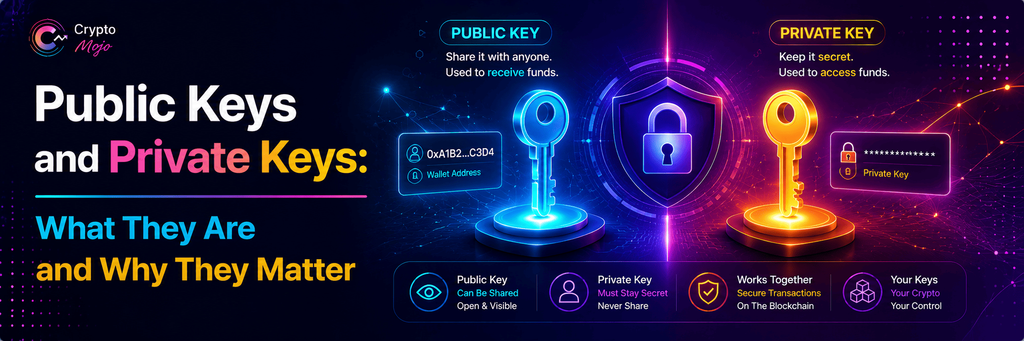
Public and private keys are essentially a pair of cryptographic codes that allow crypto ownership without the need of an intermediary such as a bank/central authority. A user’s public key can be shared with anyone; it’s the channel that other users send crypto to you. However, private keys must stay completely secret, as it’s a proof of ownership, giving you the privilege to move funds.
Almost every breakdown of cryptocurrency mechanics comes down to the same foundational terms: public and private keys. While these terms may sound too technical, the implicit concept is barely obscure or sophisticated. It is nevertheless, one of the most crucial concepts to grasp before one holds or manages cryptocurrency investments.
Contrary to other aspects of digital finance that can be learned slowly through experience, a mix up of how public and private keys operate could easily result to instant and irreversible loss of crypto assets. In short, there’s no room for trial and error. And this precise understanding is worth establishing early.
This guide dives deep into what public and private keys are, how they operate to create a cryptographic system, and why this concept holds more realistic weight than any other cryptocurrency topic especially for beginners.
Full detailed guide on Bitcoin>>
The Problem Keys Are Actually Solving
First and foremost, we need to understand why keys are in existence in the first place. In “trad” banking, ownership is traced by an institution; a bank essentially stores a record that confirms that an account belongs to a particular person, and one proves their identity with a password, ID, or other verification method put in place by that institution.
Crypto doesn’t follow this formula. There’s no intermediary keeping a list of who owns what. Rather, ownership is proven completely through cryptography; specifically, via a mathematically connected pair of keys that can validate who has the privilege/right to move a given amount of crypto, without necessarily having a person to vouch for you.
This factor is what makes cryptocurrency “trustless”. One doesn’t require to trust a company or government to confirm your identity. A user only needs to control the right private key.
What Is a Public Key?
A public key is typically a piece of cryptographic information that’s safe to share publicly. In daily crypto use, you’re likely to engage with something derived from your public key that’s commonly referred to as a wallet address.
Think of it like a bank account number. You can free to share it with anyone without the possibility of facing any risk in doing this. A person with your wallet address is able to have access to the wallet address’s transaction history on the blockchain and can essentially send crypto to it. However, they do not have the privilege to move funds.
What Is a Private Key?
Alternatively, a private key and operates very differently. It is a long, randomly generated string of characters that verifies ownership and gives you the right to authorize transactions. If public key is like a bank account number, your private key takes the form of the actual signature (and more) that approves money to move out of that account.
Here’s the most important factor: anyone who holds the given private key has complete control over the funds attached to it. This is 100% full control, with no exceptions, and no authority figure to intervene. And this is the reason why private keys need to be well safeguarded and why losing one could be a huge crisis.
How Public and Private Keys Actually Work Together
The relation between a public and private key depends on a concept referred to as asymmetric cryptography. Without diving into the math, the main idea is: your private key is used to mathematically produce your public key, however this process can’t be reversed. In other words, it’s mathematically realistic to go from private key to public key, but entirely impossible to go from a public key to determine the private key.
This one-sided relationship is how the whole system operates. One is free to share their public key or wallet address without ever disclosing their private key, because there’s no practical way for an intruder to reverse-engineer it from the public information exclusively.
When one sends a crypto transaction, your wallet makes use of your private key to generate a digital signature; which is a unique cryptographic proof that the transaction was approved by the user who holds that key, without ever exposing the key itself in the process. The network can validate this signature using your public key, verifying that the transaction is legitimate.

Olav Nilsen Quick Tip ⚡
A good analogy here: a public key operates like a padlock that any person can use to lock something (send you crypto), but only one key can open it (private key). One sharing the padlock is 100% safe; it’s the key to open it that needs to be safeguarded.
Seed Phrases: A More User-Friendly Version of Your Private Key
Private keys are long strings of random characters, which may be inconvenient for many users to write down accurately or remember. To counter this, most modern wallets adopt the concept of a seed phrase (sometimes called a recovery phrase or mnemonic phrase); which is at its core a sequence of 12 or 24 common words, produced in a particular order.
This seed phrase can computationally produce your private key, rendering it a more realistic backup strategy rather than attempting to copy a raw private key by hand. Practically, although, a seed phrase warrants exactly the same level of security as a private key itself; someone with access to your seed phrase, inherently has the same level of control over your funds as if they held the private key directly.
This is something crucial to understand as many people get it wrong constantly: your seed phrase isn’t just a “backup password.” It’s functionally equal to your private key, and it should never be typed into any digital platform, stored in a cloud, or shared with anyone, under any instance.
Olav Nilsen Quick Tip ⚡
A good habit to develop early: physically write down a seed phrase on paper and secure it somewhere safe and private, completely independent from any device linked to the internet.
What Happens If You Lose a Private Key or Seed Phrase?
This is one of the more alarming realities when it comes to crypto ownership. In case you lose access to your private key or seed phrase, without any backups, the funds attached to that key are gone permanently. You don’t get the privilege of a password reset, customer support line to recover it, or a central authoritative figure to restore access.
This is a key difference from “trad” banking, where a forgotten password can be reset via identity verification. In crypto, the private key acts as identity verification, and no other element can replace it.
It’s estimated that a huge amount of existing Bitcoin, for example, is permanently inaccessible as a result of loss of private keys from crypto’s earlier years. This was at a time when backup practices weren’t put in place. And this is the reason responsible key management is so important.
Overview of Crypto volatility>>
What Happens If Someone Else Gets Your Private Key?
The opposite situation is just as critical. If someone else gets access to your private key or seed phrase, either through a phishing scam or malware, they gain the same full control over the assets that you hold. There’s no backdoor to “lock them out” after the fact, and no way to reverse ay transaction they partake in.
This is the major reason why phishing attempts targeting seed phrases are widespread in crypto. An intruder doesn’t need to hack a secure exchange or navigate through a sophisticated encryption. They essentially only need a user to type in their seed phrase into the wrong entry.
Guide on Layer 1 vs Layer 2 blockchains>>
Custodial vs. Non-Custodial: Who Actually Holds the Keys?
This concept links directly to a greater distinction worth grasping. If you hold crypto directly in a wallet where you’re personally in control of the private key, this is referred to as a non-custodial setup. However when you leave crypto funds on a crypto exchange and allow the exchange to manage the keys on your behalf, then that’s a custodial setup.
Custodial arrangements are super convenient. One isn’t required to manage their own key security, and in case you forget your exchange password, there’s an existing standard account recovery process. However, this also means trusting that exchange’s own security and financial stability, as opposed to depending on independent cryptography that you control exclusively. The phrase “not your keys, not your coins” is derived here. A typical reminder that custodial holdings come with a layer of trust that non-custodial wallets don’t need.
Neither approach is universally right nor wrong. This will depends on what you’re essentially comfortable with, how actively you’re using the crypto, and how much accountability you’re willing to take to safeguard your crypto investments.
Best Practices for Managing Your Keys
- Never share your private key or seed phrase with anyone. Not even with wallet “support,” friends, not with anyone. Any legitimate service will never ask for it.
- Store backups physically, not digitally. Physically writing down your seed phrase on paper (or a more durable material) and keeping it somewhere safe decreases exposure to remote hacking attempts, in comparison to keeping it safe as a screenshot, note, or document.
- Consider a hardware wallet for larger holdings. These devices are specially designed to produce and store private keys without ever exposing them to an internet-linked device, adding an extra layer of protection for anything you’re not actively trading.
- Be skeptical of anything asking for your seed phrase. Any website, app, or person asking for your seed phrase directly, particularly under pressure or urgency, should be perceived as a serious red flag.
- Test your backup carefully. If possible, verify that your backup actually works, instead of assuming it does and finding out otherwise during an emergency.
Detailed guide on Stablecoins>>
Frequently Asked Questions
- Is my wallet address the same thing as my public key? No. Although they may be closely related. A wallet address is essentially a shortened, more convenient version generated from your public key, via extra processing. For practical purposes, both operate the same: safe to share, and used to receive funds.
- Can someone steal my crypto just by knowing my wallet address? No. Your wallet address only permits others to access the address’s transaction history and send funds to it. It doesn’t give any privilege to move funds out. Only your private key or seed phrase has this authority.
- What’s the difference between a private key and a seed phrase? A private key is essentialy a long string of random characters attached to a specific wallet. A seed phrase is a more convenient and friendly sequence of words that can produce one or more private keys. Practically, both need to be safeguarded with the same level of gravity, since either one gives full control over the given funds.
- Can a private key be changed if it’s compromised? Not entirely the way a password can be reset. If a private key or seed phrase is jeopardized, the best and most secure response is to move funds to another wallet with a newly generated key as fast as possible, instead of trying to use the compromised one.
- Do all cryptocurrencies use public and private keys the same way? The general concept is employed widely across most cryptocurrencies, although the particular technical implementation may be different within different blockchains. The main principle, however, remains consistent: a private key verifies ownership and authorizes transactions, while a public key or address allows others to send funds.
Conclusion
Public and private keys are the underlying infrastructure that makes cryptocurrency ownership possible without the need of a bank, government, or company standing behind it. A public key is safe to share and only permits others to send you funds. Alternatively, private key, along with any seed phrase attached to it, confirms ownership and must be well safeguarded, since whoever holds it has complete, irreversible control over the funds it secures.
Understanding this difference, and treating your private key or seed phrase with the seriousness it deserves, is a crucial habit you can build as you dive into the crypto space. Almost every major loss story in this space, coming from scams or a mere mistakes, ultimately tracks back to this concept.
Olav Nilsen
Editor-in-Chief at Crypto Mojo
Olav Nilsen is Editor-in-Chief at Crypto Mojo. He simplifies crypto and blockchain topics so readers can make smarter financial decisions, cutting through the noise with actionable insights for every trader.
This article is for educational purposes only and does not constitute financial, investment, or tax advice. Cryptocurrency involves significant risk, including the potential for permanent and irreversible loss of funds. Always conduct your own research and consult a licensed financial professional before making investment decisions.