How to Choose a Cryptocurrency Exchange as a Beginner
TL;DR
The short version
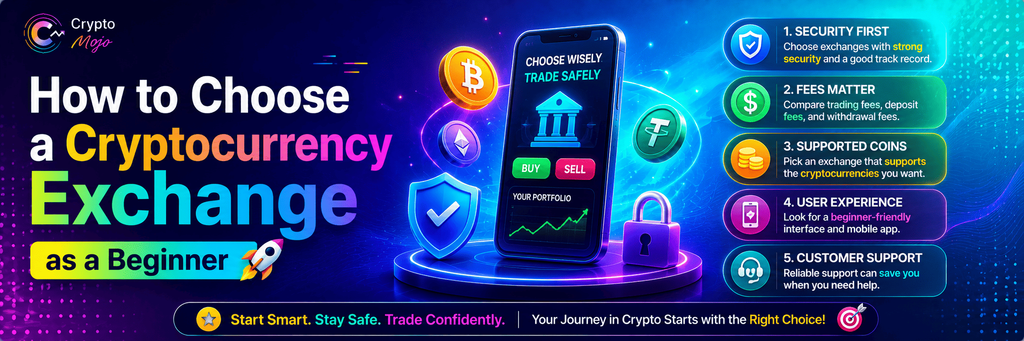
When choosing a new crypto exchange as a beginner, the major factors to consider are security background, the regulatory frameworks in your country of residence, trading fees, availability of coins, ease of use, payment system, customer support and withdrawal structure. At the core of it, there isn’t one platform that’s best for everyone. The ultimate choice typically depends on your goals, the amount you’re starting with and how much control you want to have over your assets.
If you’re just getting started with opening your first crypto exchange account, it may feel considerably complicated than it should be. There are hundreds of platforms looking to sign up new users every day, and each showcasing itself as the best in the space. In practices, this process can be mind-numbing, and it may difficult to distinguish the genuine ones, and ones that are focused on getting as many new users as possible.
This detailed guide is intended to give you all the information you need in order to make an informed decision. As opposed to offering a typical list of the top recommendations, it dives deep into the specific factors that are worth assessing when selecting an exchange, so that you make a decision that best fits your needs, and especially as a beginner.
What a Crypto Exchange Actually Does
Before getting to the nitty gritties, it’s crucial to be clear on the role that an exchange plays. A crypto exchange is essentially a platform that allows user to convert traditional currencies into cryptocurrencies, make trades, and withdraw it to your ideal wallet. There are some exchanges that are centralized (company manages the exchange) while others are decentralized (run through smart contracts).
Nevertheless, a centralized exchange is the best option for beginners as decentralized exchanges may need one to be quite conversant in running your own self-managed wallet. This makes this option less suitable for beginners.
Blockchain technology overview>>
Security: The Most important factor
Security is the most important thing, if anything. Any convenient exchange doesn’t deliver value, if it’s not built to safeguard your funds.
A few things worth checking:
Track record. Has the exchange faced any major security compromises previously? And if so, how was it resolved? A past incident is not necessarily a disqualifying factor, and especially if it occurred a couple of years back and was handled appropriately.
Two-factor authentication (2FA). A good exchange should allow 2FA as a baseline security feature as a bare minimum. The best approach would be via an authenticator app rather than SMS alone, since SMS-based 2FA tend to be more vulnerable with the advancement of technology.
Cold storage practices. Any good exchange should store a big chunk of users’ funds in offline cold storage, as opposed to wallets linked to the internet. This is a substantial way of reducing the impact of a potential hack. Many exchanges are keen to publish general information about their storage practices, which is something users should keep tabs with.
Insurance or reserve funds. There are some exchanges that preserve a dedicated fund purposely to reimburse users in case of a security breach. This may not be a guarantee of safety, but it’s a good signal that an exchange is ready for a worst-case scenario.
Public and private keys guide>>

Olav Nilsen Quick Tip ⚡
Before you sign up: search the exchange’s name in combination with terms like “hack” or “security incident” and check out the results. It may not give you the entire picture, but it’s a good way to spot obvious red flags prior to joining the platform.
Regulatory Standing and Availability in Your Country
User should understand that not every exchange runs legally, or have the same regulatory frameworks in every country. Before getting started on a platform, verify that it’s actually available and legal to operate where you live.
This matters for a couple of reasons. Exchanges that run under strong regulatory oversight are required to follow stricter standards when it comes to fund segregation, reserve reporting, and consumer protections, although this may vary substantially by country and platform. The gambling with your legal protections in case something went wrong.
Its also important to check whether an exchange needs identity verification (commonly called KYC, or “know your customer”). While this adds an additional step to finish the sign up process, it’s a signal that the exchange is compliant.
Fees: Understanding What You’re Actually Paying
Crypto exchanges may be delicate to understand, and especially for beginners. This is because most platforms list them differently, and some fees may not be visible.
Factors worth understanding:
Trading fees. These are charged as a percentage of each trade, typically lower for “maker” orders (adding liquidity to the order book) than “taker” orders (eliminating liquidity by filling an existing order instantly.) They vary between exchanges, so one should compare them directly if you plan to trade constantly.
Deposit and withdrawal fees. Depositing funds is most times free on most platforms. And, specifically via bank transfer, while card-based deposits usually carry a fee. Withdrawal fees, for crypto withdrawals, rely on network conditions as opposed to being a flat platform fee.
Spread costs. Some exchanges, especially beginner-friendly ones, build up their fee into the buy/sell spread instead of charging it separately. This may make an exchange look “fee-free” on first glance.
Don’t focus on chasing the most affordable platform. It’s more important to understand an exchange’s entire fee structure and measure it against the other factors on this list, since the cheapest option almost always is never the best fit.
Detailed guide on market cap>>
Available Cryptocurrencies
In case you already know the coins that you intend to buy, confirm the exchange actually supports them before registration. Some exchanges provide an extremely wide selection, while others deliberately keep their listings compact and more curated, as part of a stricter vetting process for which assets they’ll support.
For beginners, a smaller, well-known selection is the best approach. If you’re just getting started with something like Bitcoin or Ethereum, you don’t necessarily need access to hundreds of lesser-known tokens from the get-go, and a more curated exchange tends to reduce the temptation to hop onto unfamiliar, and assets with more risks.
Ease of Use and Beginner-Friendliness
Not all exchanges are ideal for beginners. Some platforms are built exclusively for active traders, with dense charts, advanced order types, and interfaces that are overwhelming if you just intend to buy and hold a small amount of crypto.
Be on the lookout for:
- A simple, well labeled buy/sell process
- A user-friendly mobile app with the same the desktop experience, in case you intend to use your phone mostly
- Educational resources available on the platform itself
- A simple distinction between basic and advanced trading modes, if the exchange offers both
Major exchanges now offer an easy “beginner mode” interface along with their full trading interface, which is quite convenient for beginners.
Olav Nilsen Quick Tip ⚡
Before depositing any funds, take a look at the exchange’s interface. Check the buy/sell flow, browse the fee schedule, and observe how account settings and security options are structured.
Customer Support
There’s one factor that one may overlook until you actually need it. A few things worth checking beforehand:
- Does the exchange come with a live human support, or only uses automated chatbots?
- What’s the typical response time, based on recent user reviews?
- Is support accessible in your language?
Looking out for specific user reviews (rather than an exchange’s own marketing claims) is a valid way to gauge what support actually is like.
Withdrawal Options and Limits
Depositing funds into an exchange is always the easy part. But withdrawing is where friction often shows up. Before committing to a platform, check out:
- The withdrawal methods that are supported (bank transfer, card, crypto withdrawal to an external wallet)
- If there are any existing daily or monthly withdrawal limits, especially relevant if you intend to move larger amounts
- How long withdrawals usually take to process, based on previous user experiences
Any exchange that makes depositing easy but withdrawing complicated is a signal worth taking seriously, as it give you less control over your own funds.
A Simple Framework for Making a Decision
In case the above factors are overwhelming, here’s a simplified way to approach the decision:
- Start with security and regulatory standing. These are simply non-negotiable base requirements, despite of what else an exchange delivers.
- Confirm it’s actually available in your country, and have the specific features and coins you’re particularly interested in.
- Compare fees for how you’ll actually use it -periodic small purchases have very varying cost considerations than frequent and active trading.
- Test the interface before you commit large funds, to ensure it feels manageable as opposed to intimidating.
- Keep only what you’re actively using on the exchange itself, and look into moving bigger, longer-term holdings to a wallet you have full control of, once you gain the expertise to manage one.
The last factor is important: despite which exchange you choose, approaching it as a place to actively trade instead of a permanent storage solution for substantial amounts is one of the more important habits to build earlier on. For more on this distinction, see our guide on hot wallets vs. cold wallets.
Common Mistakes Beginners Make When Choosing an Exchange
- Chasing sign-up bonuses over fundamentals. A generous welcome bonus is quite compelling, but it shouldn’t surpass security, regulatory standing, or fee structure in making your decision.
- Not checking regional availability first. It’s may be frustrating to go through an entire sign-up and verification process only to find out certain features aren’t available in your region.
- Ignoring the fee structure until after they’ve started trading. Fully comprehending fees upfront avoids unpleasant surprises once you begin buying and selling.
- Leaving large amounts on an exchange indefinitely. Exchanges offer a convenient platform for active use, but they act as a form of custodial storage. Anything you’re not actively trading, it’s worth moving to a safer, self-managed wallet.
- Skipping account security setup. Enabling 2FA and using a strong, unique password barely takes you more than 10 minutes, and it substantially reduces potential risks, despite of how secure the exchange itself is.
Frequently Asked Questions
- Is it safe to keep my crypto on an exchange? This is determined by the amount and the exchange itself. For smaller amounts you’re actively trading, securing the funds on a reputable, exchange is a reasonable approach. But for larger amounts or long-term holdings, most people prefer to move funds to a self-managed wallet, as exchange balances are technically custodial, which means the exchange holds the private keys.
- Do I need to verify my identity to use a crypto exchange? All reputable exchanges require identity verification (KYC) as part and parcel of their regulatory compliance. While it may a bit inconvenient, it’s a signal of a legitimate, compliant platform as opposed to something to avoid.
- Should I use more than one exchange? Some seasoned users do, typically to access different coins, capitalize on different fee structures, or even avoid focusing all their activity on a single exchange. For beginners, starting out at a well-researched exchange is is the simpler, option to expand later as your needs develop.
- What’s the difference between a centralized and decentralized exchange? A centralized exchange is typically run by a company that supervises the platform and holds custody of user funds. A decentralized exchange on the other hand runs through smart contracts with no central company controlling it. Usually needing users who already own their crypto wallets before making use of them.
- How do I know if an exchange’s fees are actually competitive? You have the privilege to compare and contrast the full fee structure, including trading fees, deposit/withdrawal costs, and any other spread that’s built into the buy/sell price.
Conclusion
There’s no one right crypto exchange for every beginner. The choice boils down to your country, specific goals, amount you’re starting with, and how hands-on you intend to be with the security of your crypto assets. Additionally, check on, security, regulatory standing, and trading fees to make the decision that will fit your needs long term. Ensure that you take the time to do extensive research, and approach crypto exchanges as temporary platforms to manage your crypto assets, rather than the whole picture.
Layer 1 vs Layer 2 Blockchains detailed guide>>
Olav Nilsen
Editor-in-Chief at Crypto Mojo
Olav Nilsen is Editor-in-Chief at Crypto Mojo. He simplifies crypto and blockchain topics so readers can make smarter financial decisions, cutting through the noise with actionable insights for every trader.
This article is for educational purposes only and does not constitute financial, investment, or legal advice. Cryptocurrency exchanges carry inherent risks, including regulatory, security, and market risks. Always conduct your own research and consult a licensed financial professional before making financial decisions.